

 Call us
 Email us







£0.00
0How to Move an Upright Piano Safely
Moving an upright piano safely requires planning, the right equipment, and enough people to control the load. For flat moves, a piano dolly works well – stairs and complex routes require professional handling.
Introduction
Moving an upright piano is a high-risk task that demands careful preparation, the right equipment, and coordinated handling. BIL Group’s piano dolly brands – Evo Skate and AluTruk – are trusted by removals firms to move heavy, valuable items such as pianos safely and with control.
In this guide, we’ll cover how to plan your move, choose the right equipment, and recognise when professional support is the safer option.
This guide is designed for homeowners, facilities teams, small business operators planning to move an upright piano on flat surfaces, and for those assessing when professional help is required.
Quick Summary
Moving a piano safely requires proper planning, at least three people, and the right equipment such as wooden piano dollies and removal blankets. Secure the lid, wrap the piano properly and move slowly with clear coordination. For complex moves, especially involving stairs, hiring professional movers is strongly recommended.
Can I move an upright piano myself?
- Flat route, clear access: Yes, with the right equipment and team
- One or two steps: High risk – consider using professionals
- Multiple steps/stairs, tight turns, or uneven ground: Use professional movers
Quick Navigation
4. When to Call the Professionals
5. Where to Find the Right Equipment
6. Extra Tips for Piano Owners
1. Plan the Move Carefully
Before anyone lifts a finger, assess the environment:
– Measure doorways and hallways
– Identify tight corners and level changes
– Clear pathways and protect floors
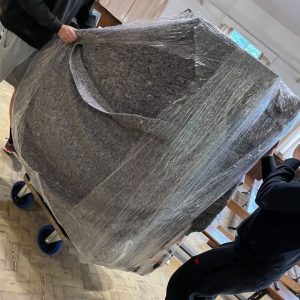
You’ll need at least three people: one on either end, and a stabiliser or guide. Use strong removal blankets to protect both the piano and surroundings. Ensure the piano lid is closed securely and no loose blanket flaps are left hanging.
2. Use the Right Equipment
A proper piano dolly or skate makes a big difference. The Evo Skate piano dollies are built in the UK and designed to carry up to 900 kg – ideal for upright pianos on flat, even surfaces.
This setup is commonly used in homes, schools, studios, and commercial environments where upright pianos need to be repositioned safely.
For more complex moves, such as steps, uneven ground, or tight access, additional specialist equipment may be required to safely stabilise and control the load. In these situations, professional movers will often use dedicated handling boards or similar support systems.
- Wooden or aluminium piano dollies: Plywood or aluminium frames with rubber surfaces or bumpers to improve grip and protect the piano during movement
- Specialist support equipment: Used by professionals to stabilise and control the piano during lifting or more complex manoeuvres
- Removal blankets: Essential for wrapping and protecting delicate surfaces – ensure lids are secured and no loose fabric is left trailing
Soft or Sensitive Ground?
Wheeled equipment can sink or mark softer surfaces such as carpet, wood flooring, or uneven ground. A floor protection plate can help create a more stable path.
The Skoots Floor Protection Plate is designed to spread the load from wheeled equipment, reducing the risk of marking or indentation while improving stability and control.
3. Moving Day Tips
Once the piano is wrapped and ready:
– Carefully tilt and lift onto the dolly
– Move slowly, keeping hands clear of crush zones
– Always have someone guiding the route
Avoid pushing from the top – use the side or base for better control. If stairs are involved, we strongly recommend using professional movers. Pianos are extremely heavy and unbalanced, and navigating steps safely requires specialist equipment, experience, and coordinated handling.
4. When to Call the Professionals
Even with great tools and planning, piano moves can go wrong. If your route includes:
– Staircases
– Tight turns
– Slippery or uneven surfaces
Then it’s best to hire trained piano movers. The cost is often less than the risk of injury or damage. We also recommend checking with Move Assured a network of professional, accredited removal companies across the UK.
Risks of DIY piano moves include:
– Back injuries from lifting incorrectly
– Property damage to walls, flooring and the piano
– Tipping or crushing hazards on uneven terrain
– Difficulty navigating tight spaces safely
5. Where to Find the Right Equipment
Explore our range of Piano Dollies at BIL Group. Our Evo Skate and AluTruk products are designed for strength and reliability, and trusted by removal professionals across the UK.
6. Extra Tips for Piano Owners
According to BIL Group’s handling specialists, controlled movement and load stability are the most important factors when moving heavy items such as pianos. If you’re moving a piano you care deeply about, consider the following:
– Don’t lift by the legs – They’re often decorative and can break under pressure. Always lift from the base or underside.
– Avoid thick carpets or gravel – These surfaces can destabilise wheels or cause tipping.
– Let the piano re-acclimate – Wait 24–48 hours before playing or tuning to let internal components settle.
– Check your insurance – Confirm whether your home or removals insurance covers high-value instruments in transit.
– Book a tuning – Pianos typically need tuning after relocation due to vibration and humidity changes.
Common Mistakes to Avoid
- Attempting stairs without professional help
- Lifting by the legs or top panel
- Using unsuitable wheels on soft ground
- Rushing the move without a clear route plan
Further Reading
Top 5 rules for safe Manual Handling
FAQ
Q: Can I move a piano by myself?
A: No. Always have at least 2–3 people involved.
Q: How heavy is an upright piano?
A: Upright pianos typically weigh between 180 and 250 kg, depending on the model. Larger models may exceed this. For context, this is heavier than a standard washing machine and difficult to control due to uneven weight distribution.
Q: What is a piano skid?
A: A piano skid (also known as a piano board) is a reinforced support used by professional movers to stabilise and secure a piano during transport, particularly on stairs or uneven routes. For these types of moves, specialist equipment and experience are typically required.
Q: What kind of dolly is best for a piano?
A: A purpose-built piano dolly, typically with a wooden platform or aluminium frame and a non-slip rubber surface, is best for moving upright pianos on flat, even ground. These are designed to distribute weight evenly and provide controlled movement. Options are available within the Evo Skate range from BIL Group.
Q: Do you offer equipment for hire?
A: We sell, not hire, but our team can help you choose the right long-lasting product for your needs. Upright pianos typically weigh between 180 and 250 kg depending on the model. Want help choosing the right piano dolly? Speak to our team.
Q: Can a piano be moved on carpet?
A: Yes, but soft surfaces can reduce stability. Using a solid wheeled dolly and, where needed, a floor protection plate can help maintain control.
Q. How long does it take to move an upright piano?
A: A straightforward move on a flat surface over short distances can take 30 to 60 minutes with the right team and equipment.
More complex moves, especially those involving stairs or restricted access, can take significantly longer and should be handled by professionals.
Disclaimer
This guide provides general advice for moving upright pianos. Every move is different, and conditions may vary. If you are unsure, always seek professional assistance.